
Each-Way Betting Explained: The Complete Racing Guide
 Available in US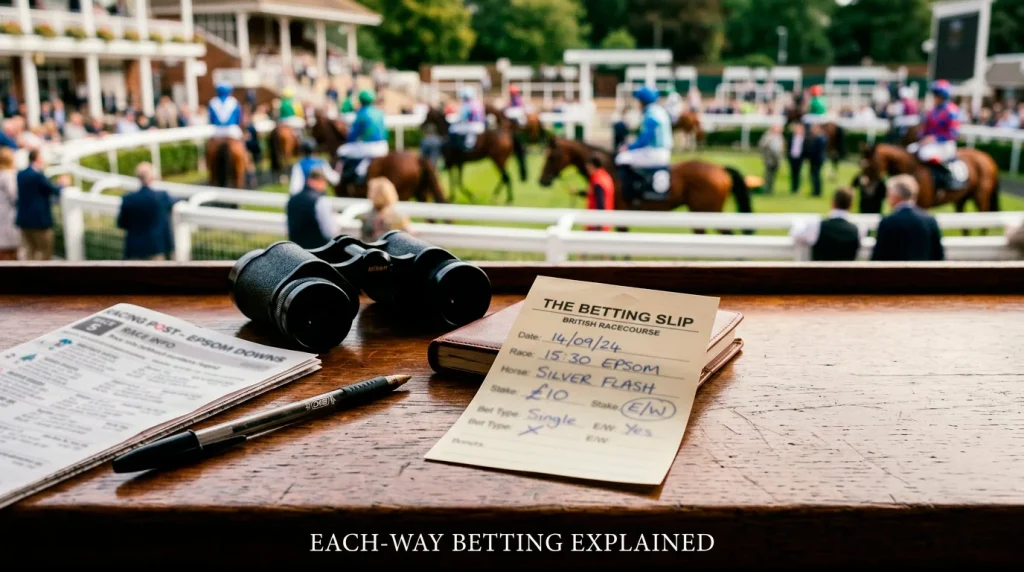
The place component pays at a fraction of the win odds, typically one quarter or one fifth depending on field size and race type. Place terms also specify how many positions count as placing: usually two, three, or four depending on the number of runners. Understanding these variables determines whether each-way betting offers value in specific situations.
Each-way betting suits certain racing scenarios better than others. Big-field handicaps where outsiders frequently place, festival races with enhanced terms, and competitive contests without dominant favourites all create conditions where the place portion carries meaningful value. Backing short-priced favourites each-way rarely makes mathematical sense, while backing genuine outsiders in suitable races can provide security without sacrificing too much upside.
The mechanics seem straightforward once you grasp the core concept, but maximising each-way value requires attention to detail. Place terms vary by race type and bookmaker. Extra places promotions change the mathematics significantly. Field size affects both place terms and realistic placing chances. This guide works through each element so you can identify when each-way betting makes sense and when simpler win-only bets serve you better.
Each-Way Betting Explained — More on this topic at horse racing betting sites.
How Each-Way Works
The win part of an each-way bet functions identically to a standard win bet. You stake money on a horse to finish first. If it wins, you receive your stake back plus winnings calculated at the quoted odds. If it does not win, you lose that stake. Nothing distinguishes the win component from any other win bet in racing.
The place part operates differently. Your stake backs the horse to finish within a specified number of positions, typically first, second, or third, though this varies by race. The payout uses a fraction of the win odds rather than separate place odds. If win odds stand at 10/1 and place terms offer one quarter odds for three places, your place bet pays at 10/4 (2.5/1) if the horse finishes first, second, or third.
Remote betting on British horse racing generated £766.7 million in gross gaming yield during the year to March 2026. Each-way betting represents a significant portion of that activity, particularly on major race days when casual punters join regular bettors.
When your horse wins, both bets pay out. Using the 10/1 example with quarter-odds place terms and a £10 each-way stake (£20 total), winning returns £100 from the win bet (£10 at 10/1) plus your £10 stake, and £25 from the place bet (£10 at 2.5/1) plus your £10 stake. Total return: £145, comprising £125 profit plus your £20 stake.
When your horse places but does not win, you lose the win stake but collect the place payout. Same example, horse finishes third: you lose £10 on the win bet, receive £25 plus £10 stake from the place bet. Net position: £15 profit on your £20 outlay. The place portion salvages something from selections that run well without winning.
When your horse finishes outside the places, both bets lose. You forfeit the entire £20 stake with no return. This outcome mirrors a losing win-only bet except you have staked double the amount, meaning bigger losses when selections disappoint.
The key insight involves recognising that each-way betting costs twice as much as win-only betting for the same selection. You are not getting free insurance on the place portion; you are paying for it through doubled stake. Whether that payment makes sense depends on the odds, place terms, and realistic assessment of placing probability.
Place Terms Explained
Place terms define two variables: how many positions count as placing and what fraction of the win odds applies to the place payout. Standard industry terms follow consistent patterns based on runner count and race type, though bookmakers can offer enhanced terms as promotions.
Races with five to seven runners typically offer two places at one quarter odds. Your place bet pays if the horse finishes first or second, at 25% of the win price. A 12/1 shot that finishes second returns 3/1 on the place portion. With only two places available in smaller fields, the place element carries less value unless your selection has strong place prospects.
Races with eight to fifteen runners generally offer three places at one fifth odds. The place bet wins on first, second, or third, paying 20% of win odds. The increased place count improves chances of collecting, but the reduced fraction offsets some value. A 10/1 shot placing third returns 2/1, lower than the quarter-odds equivalent but across more positions.
Handicap races with sixteen or more runners typically offer four places at one quarter odds. The combination of more places and better fractional terms creates the most favourable each-way conditions. Big-field handicaps attract each-way specialists precisely because four-place quarter-odds terms provide genuine place value on longer-priced selections.
Non-handicap races with sixteen or more runners sometimes offer only three places at one fifth odds, depending on the bookmaker and race. Check terms before betting, as assumptions based on runner count can prove incorrect for certain race types.
Some races carry enhanced place terms as standard. The Grand National traditionally pays on more places than standard terms, often five or six due to the unique nature and field size. Bookmakers compete on place terms for major festivals, sometimes offering four, five, or even six places where standard terms would specify fewer.
Individual bookmaker terms vary, particularly during promotional periods. One bookmaker might offer four places on a race where another offers three. Comparing terms across bookmakers before placing each-way bets identifies the best value, just as comparing win odds identifies the best price. Place terms matter as much as odds when evaluating each-way value.
Rule 4 deductions apply to each-way bets when horses withdraw after you have placed your bet. Both win and place portions face proportionate deductions based on the withdrawn horse’s odds. Substantial deductions can undermine each-way value, particularly if multiple withdrawals occur.
Each-Way Calculations
Calculating each-way returns requires working through both bet components separately then combining the results. The process becomes automatic with practice, but understanding the mathematics helps you assess value before placing bets.
Start with the win component. Multiply your win stake by the decimal odds (or convert fractional odds to decimal by dividing numerator by denominator and adding one). A £10 win stake at 8/1 fractional odds (9.0 decimal) returns £90 including stake if the horse wins. The profit is £80.
Calculate the place component using the place fraction. At 8/1 with quarter-odds place terms, the place odds become 2/1 fractional (3.0 decimal). A £10 place stake at these odds returns £30 including stake. If the horse places but does not win, this £30 minus the £10 lost on the win bet leaves £10 profit from your £20 total stake.
Eighty-five percent of gamblers cite the chance to win money as their primary motivation. Understanding exactly what each-way bets can return helps align expectations with realistic outcomes.
Combined winning returns use both calculations. An 8/1 each-way winner at quarter-odds terms with £10 each-way stake returns: £90 win component plus £30 place component equals £120 total return on £20 stake. Profit is £100. Compare this to a £20 win-only bet at 8/1, which would return £180 for £160 profit. The each-way structure trades maximum upside for place protection.
Breakeven analysis reveals minimum place odds needed for each-way to match win-only value. If you believe a horse has X% chance of winning and Y% additional chance of placing without winning, you can calculate whether each-way offers better expected value than a win-only bet at twice the stake. The mathematics favour each-way at longer odds where place returns cover the lost win stake more comfortably.
Consider a 20/1 shot in a competitive handicap with four places at quarter odds. The place portion pays 5/1. If you estimate 10% place probability and 3% win probability, expected each-way value exceeds win-only betting because the place portion carries positive expectation that offsets some win-portion overround.
Realistic probability assessment remains the challenge. Bookmaker odds imply probabilities including margin, so backing horses at their actual odds rarely delivers long-term profit. Each-way betting works when your probability estimates exceed implied odds on the place portion, which happens more frequently with outsiders in big fields than favourites in small fields.
When to Bet Each-Way
Each-way betting makes mathematical sense in specific situations where place probability significantly exceeds implied odds. Identifying these situations requires understanding race dynamics, field composition, and realistic assessment of your selection’s chances.
Big-field handicaps represent the classic each-way scenario. Sixteen or more runners with four places at quarter odds creates conditions where outsiders can place at reasonable frequency. A 20/1 shot in a competitive handicap has realistic placing chances that the 5/1 place odds (quarter of 20/1) underestimate if the race lacks dominant form. Each-way value exists when you assess place probability higher than the 16.7% implied by 5/1 odds.
Competitive races without strong favourites suit each-way betting better than races with dominant market leaders. When the favourite trades at 2/1 or shorter, their presence compresses place value for others. When betting heat spreads across multiple contenders, place probabilities distribute more evenly, potentially creating value on outsiders.
“The disappointing headline is that total betting turnover on British racing has fallen by 6.8% compared with last year, and 16.5% compared with two years ago,” observed BHA’s Racing Report 2026. Smart betting strategies that identify genuine value help punters make the most of their betting activity in a challenging market.
Course and distance suitability creates each-way opportunities. A horse with proven form at a specific track might have higher place probability than odds suggest, particularly if returning to favoured conditions after less suitable recent runs. The market often undervalues track specialists.
Festival races with enhanced place terms shift the mathematics significantly. When bookmakers offer five or six places instead of standard four, each-way value increases substantially. The same 20/1 shot has meaningfully better expected value when one more place counts as a winning position.
Maiden races with large fields and unknown quantities can offer each-way value on horses showing potential despite limited form. Unraced or lightly-raced horses entering competitive maidens might place at probabilities exceeding their odds-implied chances.
Avoid each-way betting on short-priced selections. A 3/1 shot pays only 3/4 (0.75/1) on the place portion at quarter odds. If it places without winning, you receive £17.50 on a £10 place stake but lose £10 on the win stake, netting only £7.50 from £20 committed. The place portion barely offsets the lost win stake, providing minimal protection for double the outlay.
Extra Places Promotions
Extra places promotions extend the number of paying positions beyond standard terms. When a bookmaker advertises “paying 6 places” on a race where standard terms offer 4, those additional positions create genuine value for each-way bettors. The promotion effectively reduces bookmaker margin on the place portion while increasing your chances of collecting.
Major bookmakers compete on extra places during high-profile racing. Cheltenham, Royal Ascot, Grand National day, and other festival fixtures attract promotional extra places as operators seek to draw customers. Comparing extra places offers across bookmakers before placing each-way bets identifies the most generous terms.
Extra places work best combined with outsider selections in big fields. A horse finishing sixth in a 24-runner handicap returns nothing under standard terms but pays out under a six-places promotion. The additional positions capture horses that run well without reaching the standard place frame, exactly the outcome each-way betting seeks to protect.
Not all extra places offers carry equal value. Paying one extra place on a race where standard terms already offer four places adds less marginal value than paying two extra places on a race with three standard places. Assess promotions relative to baseline terms rather than absolute place numbers.
Some bookmakers offer extra places as account-wide promotions; others apply them to specific races. Understanding which approach your bookmaker uses helps you plan betting activity. Account-wide extra places favour consolidating each-way betting with that operator; race-specific promotions require checking offers for each bet.
Extra places can justify each-way betting on races where standard terms would not support it. A 10-runner race with standard three places at fifth-odds offers limited each-way appeal. The same race with five places paid at fifth-odds becomes more attractive, as two additional positions create realistic place prospects for each-way selections.
Track extra places offers carefully during festival weeks when multiple bookmakers run competing promotions. The differences between paying four, five, or six places can significantly affect expected each-way returns, particularly on outsiders where additional places meaningfully improve collection probability.
Each-Way on Festivals
Festival racing creates peak each-way betting conditions. Large fields, competitive races, enhanced bookmaker terms, and extra places promotions combine to make each-way betting more attractive than during ordinary racing. Understanding festival-specific dynamics helps you maximise each-way value during these premium meetings.
Cheltenham Festival features consistently large fields across its four days. Many races attract 16+ runners, triggering four-place terms at quarter odds as standard. Bookmaker competition drives extra places offers, sometimes extending to five or six places on the biggest races. The combination of field size, competitive racing, and promotional generosity makes Cheltenham the annual highlight for each-way bettors.
Nearly 4.8 million people attended British racecourses in 2026, with festivals accounting for disproportionate attendance and betting activity. These peak events attract recreational punters who often prefer each-way betting for the place safety it provides.
The Grand National offers extended place terms as standard, typically paying on more positions than any other race. Six places at quarter odds creates exceptional each-way conditions on a race already suited to outsider place prospects. The unique nature of the National, with its attrition and unpredictability, means horses at long odds have realistic chances of placing that justify each-way stakes.
Royal Ascot brings big-field handicaps with enhanced terms from competing bookmakers. The Royal Hunt Cup, Wokingham, and other cavalry charges regularly feature 20+ runners with four or more places. Bookmaker promotions push place numbers higher, sometimes paying on results that would not count under any standard terms.
Festival strategy involves identifying races with the most favourable each-way conditions. Not every festival race suits each-way betting; small-field Group races with dominant favourites offer poor value despite the premium setting. Target the big handicaps, competitive maidens, and races where enhanced terms significantly improve place expectations.
Early pricing during festival weeks sometimes offers better each-way value than raceday markets. Ante-post each-way bets can capture generous odds before markets tighten, though you lose stakes if selections do not run. Balance the value of early prices against non-runner risk based on your confidence in participation.
Each-Way Mistakes
Backing short-priced favourites each-way wastes money. A 2/1 favourite pays only 1/2 (0.5/1) on the place at quarter odds. If it finishes second, you receive £15 total on a £10 place stake (£10 stake plus £5 profit) but lose £10 on the win stake. Net position: £5 loss on your £20 outlay. The place return fails to offset the lost win stake, meaning you would have been better with a £20 win-only bet or smaller each-way stake.
Ignoring place terms before betting leads to unpleasant surprises. Assuming quarter odds when a bookmaker offers fifth odds, or expecting four places when only three apply, undermines value calculations. Check terms on every each-way bet rather than relying on assumptions based on runner count.
Betting each-way in small fields rarely makes sense. A six-runner race with two places at quarter odds means only two horses collect place returns. Your selection needs to beat four others just to place, at which point it might reasonably have won anyway. Small fields concentrate place value too narrowly for outsiders to justify each-way stakes.
Chasing each-way insurance when win-only offers better value represents another common error. Some punters default to each-way betting for the psychological comfort of potential place returns. If your genuine assessment favours a horse winning rather than merely placing, a larger win-only stake may offer superior expected value.
Forgetting that each-way doubles your stake creates bankroll management problems. A £10 each-way bet requires £20. Ten £10 each-way bets across a day’s racing commits £200. Punters who mentally account for their each-way stakes at face value rather than actual cost risk overstaking relative to intended betting levels.
Failing to compare bookmaker terms surrenders value unnecessarily. Different operators offer different place terms on the same race. The difference between three and four places, or between fifth and quarter odds, significantly affects expected returns. Shopping for best terms should accompany shopping for best prices.
Each-Way vs Win-Only
The choice between each-way and win-only betting depends on your probability assessment, the odds available, and place terms offered. Neither approach is universally superior; each suits different situations.
Win-only betting offers better value when you believe a horse’s win probability exceeds its place probability by a margin that justifies forgoing place insurance. A horse you assess at 20% win probability in a five-runner race (implying roughly 35% place probability for first or second) might warrant win-only betting because the place portion adds relatively little marginal value.
Forty-eight percent of British adults gambled within the past four weeks, and betting strategies differ substantially across this population. Understanding when each approach works helps you bet more effectively regardless of your experience level.
Each-way betting suits scenarios where place probability significantly exceeds win probability in ways that create value at offered place odds. A 20/1 outsider in a 24-runner handicap might have 5% win probability but 20% place probability across four positions. The place portion at 5/1 (quarter of 20/1) implies 16.7% probability, so 20% actual probability creates positive expected value on the place element.
Breakeven calculations help determine which approach suits specific situations. If a horse at 10/1 has X% win probability, the minimum place probability needed for each-way to match win-only expected value depends on place terms. At quarter odds, the place pays 2.5/1, implying 28.6% probability. If you assess place probability above 28.6% and win probability below 9.1% (the implied win probability at 10/1), each-way offers better expected value.
Portfolio thinking suggests mixing both approaches based on circumstances rather than defaulting to one style. Use win-only betting on favourites and horses in small fields where place terms offer minimal value. Use each-way betting on outsiders in big-field handicaps and races with enhanced place terms. The combined approach captures value where it exists across different race types.
Stake management differs between approaches. If you typically bet £10 on selections, a win-only bet costs £10 while an each-way bet costs £20. Maintaining consistent risk exposure means reducing per-selection stakes when betting each-way, or accepting doubled exposure as the price of place insurance. Neither is wrong, but understanding the stake implications prevents unintended overexposure.
Two Bets, One Selection
Each-way betting offers valuable protection on longer-priced selections in suitable races. The structure of two bets in one, backing both win and place on your selection, lets you collect returns even when horses run well without winning. Understanding place terms, calculating realistic probabilities, and identifying races with genuine each-way value separates profitable use from mechanical habit.
Focus each-way betting on big-field handicaps, festival races with enhanced terms, and situations where place probability exceeds odds-implied expectations. Avoid backing favourites each-way, betting on small fields where place terms offer minimal value, and ignoring term variations between bookmakers. The mathematics favour disciplined application rather than reflexive use.
Extra places promotions amplify each-way value during major meetings. Comparing bookmaker offers identifies the most generous terms. Combined with sensible selection and realistic probability assessment, each-way betting becomes a useful tool within a broader racing betting approach rather than a standalone strategy.
See also How to Bet on Horse Racing.
